
Norton AntiVirus Plus in 2026: what the tier includes, what it does not, and who it suits
This page contains paid partner links to Norton. If you buy a subscription after following one, Consortexa s.r.o. receives a commission from the advertiser. You pay no more than you would otherwise, and the commission does not change what is written here. Consortexa s.r.o. is not affiliated with, endorsed by or sponsored by Norton or Gen Digital Inc. Read our editorial policy and affiliate disclosure.
Norton AntiVirus Plus is the entry tier of Gen Digital’s consumer security line. It is frequently described — including in an earlier version of this page — as a multi-device suite with a bundled VPN. It is neither. This article sets out what the tier actually covers, explains the technology behind the marketing terms, and gives you a way to judge whether you need it.
- ProductNorton AntiVirus Plus — the entry tier of the Norton consumer range
- VendorGen Digital Inc. (the company formed when NortonLifeLock and Avast merged in 2022)
- PlatformsWindows and macOS. Not an Android or iOS product.
- Devices coveredMarketed as a single-device subscription — one PC or one Mac
- BillingAnnual subscription with a discounted first term that auto-renews at the standard rate unless cancelled
- Not in this tierSecure VPN, Dark Web Monitoring, SafeCam, parental controls, identity-theft cover
- Verify before buyingDevice counts, storage allowances and prices differ by country and by promotion. Norton’s own product page and order screen are the authoritative source; where this page and Norton diverge, Norton prevails.
What “AntiVirus Plus” means in Norton’s line-up
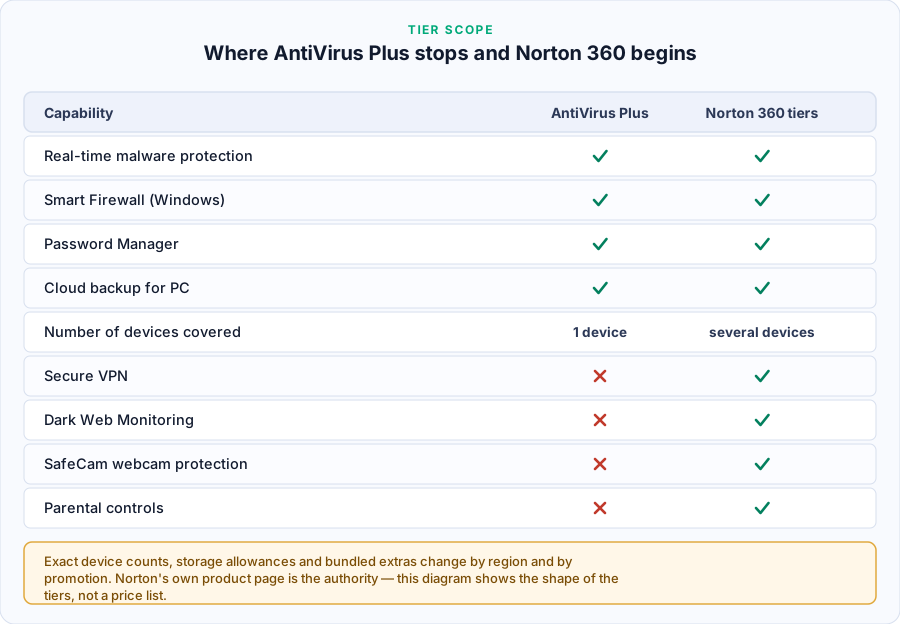
Norton sells consumer protection as a ladder of subscription tiers rather than as a single product. AntiVirus Plus sits at the bottom of that ladder. Everything above it is branded Norton 360 and adds services rather than a fundamentally different scanning engine: more devices, more cloud storage, a VPN, monitoring services, and in some markets identity-theft cover.
This matters because the malware protection itself is largely common across the range. If you buy the entry tier you are not buying a weaker scanner; you are buying the same core engine with fewer bundled services and a smaller licence. Conversely, if you buy an upper tier hoping for better detection, that is not principally what you are paying for.
What the tier includes
Based on Norton’s published description of the tier at the time of writing, an AntiVirus Plus subscription provides:
- Real-time malware protection. Files are inspected as they are written, opened and executed, rather than only during a scheduled scan.
- Smart Firewall (Windows). A firewall that controls which programs on the machine may talk to the network, in addition to the inbound filtering Windows already performs. On macOS the platform’s own firewall is used instead.
- Password Manager. A browser-integrated vault for credentials. It is a genuine password manager, not a browser autofill wrapper, but it is tied to the Norton account.
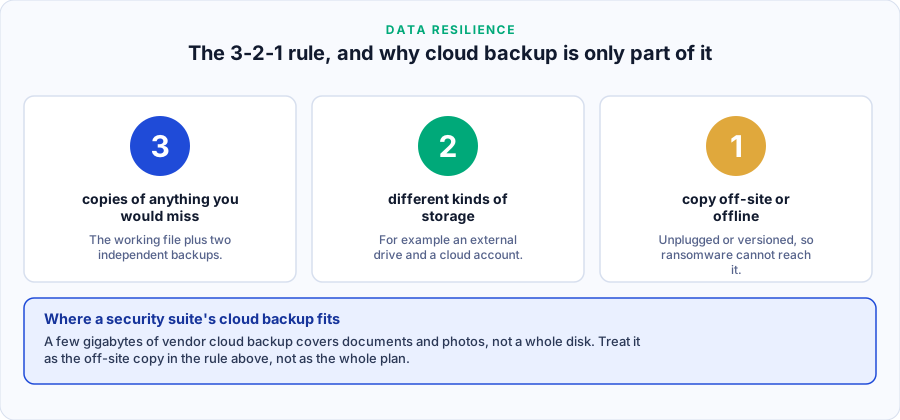
- Cloud backup for PC. A small storage allowance — Norton lists 2 GB for this tier — for selected documents and photos. It is Windows-only and is sized for personal files, not for imaging a disk.
- Virus Protection Promise. Norton’s commitment that if a device covered by an eligible subscription gets infected and their support team cannot remove the infection, they will refund the subscription. It is a support and refund commitment with published conditions attached, not a guarantee that nothing will ever get through.
Storage allowances and device counts in this range have changed more than once, and they differ between the Czech, other EU and US storefronts. Treat the 2 GB figure as Norton’s listed allowance at the time of writing and confirm it on the order screen before you pay.
If you subscribe after following this partner link, Consortexa s.r.o. receives a commission from the advertiser. It costs you nothing extra and does not affect the price you are shown.
What it does not include
This is where most descriptions of the product — including the earlier version of this page — go wrong. The following are not part of AntiVirus Plus:
- Norton Secure VPN. The VPN is a Norton 360 component. If you want it, the entry tier is the wrong purchase; buying AntiVirus Plus and expecting a VPN will leave you buying a second subscription.
- Multi-device and mobile coverage. The tier is a single-device licence for a PC or a Mac. Phones and tablets are not covered.
- Dark Web Monitoring, which checks whether your credentials appear in known breach data.
- SafeCam webcam access alerts and parental controls.
- Identity-theft protection. The LifeLock-branded services are a separate product line with limited country availability.
If you have one computer and want malware protection, the entry tier is the product Norton designed for you. If you have a household of laptops and phones, or you specifically want a VPN, compare the Norton 360 tiers instead — the entry tier will not scale to it, and buying it first usually costs more in the end.
How the detection engine actually works
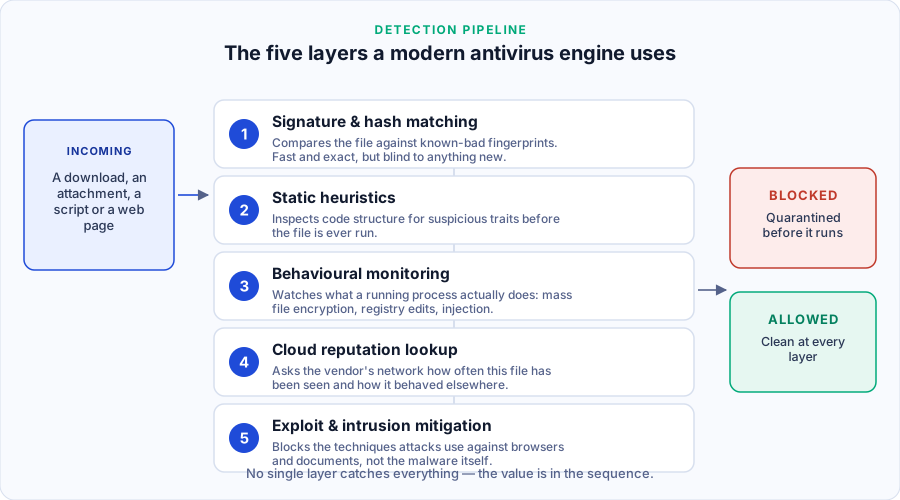
“Antivirus” is a legacy name. No serious consumer product today relies on matching known virus signatures alone, because attackers recompile and repack their payloads faster than signature lists can be distributed. What modern engines — Norton’s included — run is a sequence of independent checks, each of which catches a class of threat the others miss.
Signature and hash matching
The oldest technique: compare the file against fingerprints of known-bad code. It is fast, exact and produces almost no false positives, and it is useless against anything the vendor has not seen before.
Static heuristics
Inspecting a file’s structure without running it — packing, obfuscation, unusual imports, a document that contains a macro which contacts the network. This catches variants of known families, and it is the layer most likely to flag a legitimate but unusual program by mistake.
Behavioural monitoring
Watching what a process does once it is running: enumerating and rewriting large numbers of files, injecting into another process, deleting shadow copies, disabling recovery. This is the layer that stops ransomware families nobody has catalogued yet, because the behaviour is the signature.
Cloud reputation
The engine asks the vendor’s network what it knows about this exact file: how many other installations have seen it, how old it is, how it behaved elsewhere. A binary first observed four minutes ago on three machines worldwide is treated very differently from one seen on twenty million machines for three years. This is also the layer with the clearest privacy implications, because it means file metadata leaves your machine — Norton documents this in its own privacy notices, and it is worth reading them.
Exploit mitigation
Blocking the techniques an attack uses to gain execution through a flaw in a browser, a document reader or an office application — things like unexpected code execution from a data region. It does not repair the underlying flaw. Only the software vendor’s own update does that, which is why security software is a complement to patching and never a substitute for it.
Where threats actually come from
The common assumption is that infection follows from downloading something disreputable. In practice the delivery routes that matter for ordinary home users are broader, and several of them involve no download at all. European reporting from ENISA and Europol’s IOCTA series consistently puts social engineering, credential abuse and exploitation of unpatched software among the dominant routes, rather than classic file-borne viruses.
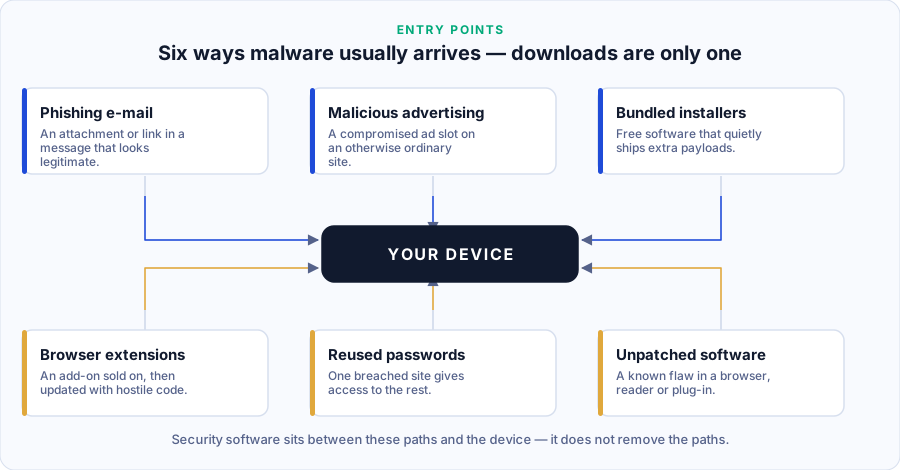
Two of those six routes are not malware problems at all. Reused passwords are a credential problem: no scanner can help you when somebody signs in to your account with the correct password. Unpatched software is a maintenance problem, addressed by enabling automatic updates. This is the honest case for a bundled password manager — it addresses a route the scanner cannot reach.
Ransomware, and why backup is the real answer
Ransomware is the threat most often used to sell consumer security software, and it is the one where software alone is least sufficient. An attack proceeds in stages, and a defence can interrupt it at several of them — but once encryption has completed, no security product can undo it.
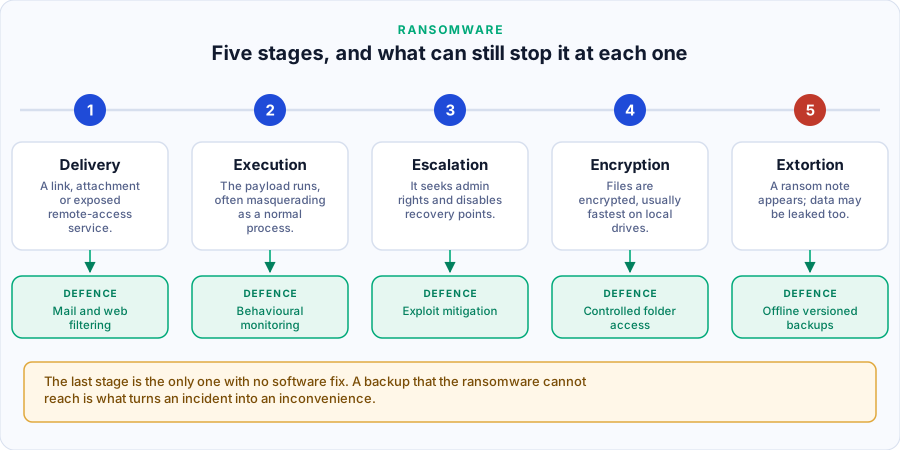
This is the context in which to read a cloud-backup allowance. A few gigabytes is not a disaster-recovery plan, but it is a meaningful off-site copy of the files most people would actually miss: documents, tax records, photographs. Sized honestly, it is one leg of the long-standing 3-2-1 rule that backup practitioners and CISA’s StopRansomware guidance both recommend.
If you subscribe after following this partner link, Consortexa s.r.o. receives a commission from the advertiser. It costs you nothing extra and does not affect the price you are shown.
What independent laboratory scores mean
Three laboratories dominate consumer antivirus testing in Europe: AV-TEST in Germany, AV-Comparatives in Austria, and SE Labs in the United Kingdom. Norton’s consumer engine has been a regular participant in their public test rounds and has generally scored well in them. We are deliberately not reproducing a specific percentage here: the figures change with every test round, and a number quoted without its test date and sample set is close to meaningless.
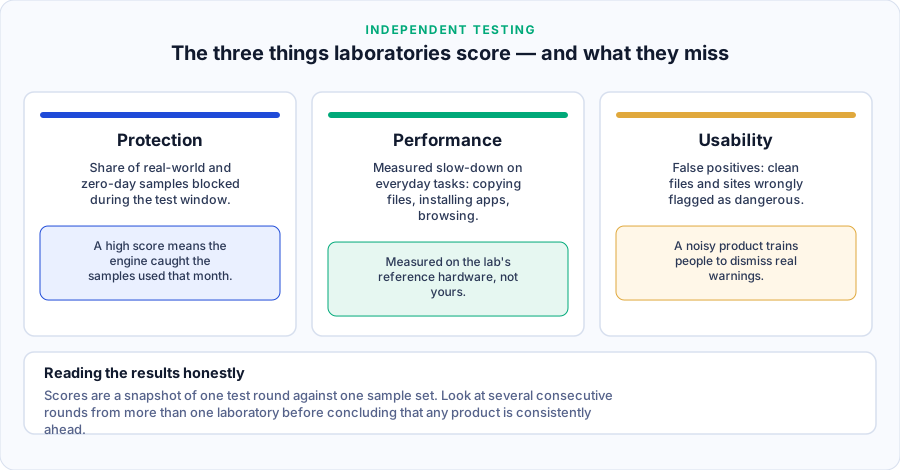
How to use these sources properly: open the laboratory’s own site rather than a summary of it, look at three or four consecutive rounds instead of one, and check all three categories. A product with a near-perfect protection score and a poor usability score is training its user to click “allow”, which eventually undoes the protection. Note also that the leading consumer engines cluster tightly at the top; the practical gap between the best few is usually narrower than marketing on any side suggests.
Performance impact
The complaint that security software makes a computer sluggish is decades old and is now mostly historical on current hardware. Real-time scanning costs most during bulk file operations — unpacking a large archive, installing software, the first full scan after installation — and relatively little during ordinary use. On a machine with an SSD and 8 GB of RAM or more, most users will not notice it.
Two situations where it is still worth attention: older laptops with mechanical hard drives, where a full scan is genuinely disruptive and should be scheduled for idle hours; and developer or build machines, where scanning large working directories can add real time to compilation and a considered exclusion is appropriate. If you want figures rather than impressions, the performance category in the laboratory reports above is the place to look — measured on their reference hardware, not yours.
Do you need this if you already have Microsoft Defender?
It is a fair question and it deserves a straight answer rather than a sales one. Microsoft Defender Antivirus is built into Windows, is enabled by default, costs nothing, and has in recent years scored competitively in the same public laboratory tests discussed above. For a careful user on a fully updated Windows machine it is a legitimate baseline, and Microsoft documents its behaviour publicly.
The arguments for paying for a third-party product are narrower than the advertising suggests, but they are real:
- The bundle. You are buying a password manager, a firewall with outbound control and a backup allowance alongside the scanner. Whether that is good value depends on whether you would otherwise pay for those separately.
- Cross-platform. Defender’s consumer antivirus is a Windows component. A Mac in the household is not covered by it.
- Support. A paid subscription comes with a support channel and, in Norton’s case, a removal-or-refund commitment. Free software comes with a forum.
- A second opinion. Different vendors miss different things in any given week.
What is not a good argument is the implication that an unprotected-looking Windows machine is defenceless. It is not, and any page that tells you otherwise is selling something.
Price, renewal and your rights as an EU consumer
We do not publish prices on this page, because consumer security subscriptions are sold on rotating promotions and any figure we printed would be wrong within weeks. What is stable is the structure, and it is worth understanding before you buy:
- The first term is discounted. The advertised headline price is almost always an introductory rate for the first year.
- It auto-renews at the standard rate. Renewal is typically charged to the stored payment method at a materially higher price than the introductory one. This is disclosed in Norton’s terms; people are surprised by it anyway. Check the renewal price on the order screen, not just the price you are paying today.
- You can turn auto-renewal off in the Norton account area, generally without losing the term you have already paid for.
- Money-back guarantee. Norton advertises a money-back guarantee on annual subscriptions — commonly 60 days — with its own published conditions. Verify the current period and conditions at the point of purchase.
Separately from any commercial guarantee, EU consumer law gives you a 14-day right of withdrawal on distance contracts. For downloadable digital content, that right can lapse once supply begins, if you have given express prior consent to immediate supply and acknowledged the loss of the withdrawal right — which is what the checkbox on a software checkout normally is. Read it rather than clicking past it. A trader’s own guarantee can be more generous than the statutory minimum but cannot reduce it. This paragraph is general information, not legal advice.
Who it suits — and who it does not
A reasonable fit if
- You have one Windows PC or one Mac that matters to you and you want managed protection for it.
- You want a password manager and a scanner from a single vendor with one bill and one support route.
- You would rather a product made the security decisions than configure them yourself.
- You are on a Mac and therefore outside Microsoft Defender’s consumer coverage.
Probably the wrong purchase if
- You want a VPN — it is not in this tier, and this is the single most common misunderstanding about it.
- You need to cover a household of laptops, phones and tablets; the single-device licence will not stretch and a Norton 360 tier is the like-for-like comparison.
- You keep Windows patched, use a password manager already, and are comfortable with Defender — in which case you are buying convenience and support, not a step change in protection.
- You want granular control over rules and exclusions; consumer suites deliberately hide that.
A short checklist before you buy
- Count the devices you actually want covered, then check the licence covers that number. If it is more than one, this is not the tier.
- Write down whether you need a VPN. If yes, compare Norton 360 tiers instead.
- Read the renewal price on the order screen, not the headline price.
- Check the storage allowance and platform limits for the backup component if that is part of why you are buying.
- Confirm the money-back period and its conditions as stated by Norton on the day you buy.
- Before or after purchase, turn on automatic updates for Windows or macOS and for your browser. It costs nothing and closes one of the six routes above.
If you subscribe after following this partner link, Consortexa s.r.o. receives a commission from the advertiser. It costs you nothing extra and does not affect the price you are shown.
Corrections to an earlier version of this page
An earlier version of this article, published on this domain, contained claims we could not support. In line with our corrections policy we are recording what was changed rather than quietly deleting it:
- It stated that the product “bundles a VPN and 1 GB of cloud backup”. Norton Secure VPN is not part of the AntiVirus Plus tier, and the backup figure was wrong; Norton lists 2 GB for this tier.
- It stated that “one subscription covers your PC, Mac, and mobile devices” and described “multi-device coverage” as an advantage. The tier is a single-device licence and does not cover mobile platforms.
- It said exploit protection “patches the way your browser and Office apps behave”. Exploit mitigation blocks exploitation techniques at runtime; it does not patch anything. Only the software vendor’s update does.
- It asserted that independent laboratories had “repeatedly placed Norton at or near the top of detection-rate charts”, with no source and no test date. That claim has been replaced with a sourced, dated explanation of what laboratory scores measure and links to the laboratories themselves.
- It claimed the bundle “typically works out cheaper” than assembling equivalent tools. We have no pricing evidence for that comparison, so it has been removed.
- It was framed as a “reader story” and a “reader-submitted story”. It was not. The page is editorial content written by a named author and is now labelled as such.
- Closing copy urging readers to “grab” the product and calling it “a very hard product to beat” has been replaced with a conditional recommendation that states who the product does not suit.
Sources
- Norton — Norton AntiVirus Plus product page and the regional Norton storefront applicable to your country (tier contents, device counts, storage allowance, guarantee terms).
- Gen Digital Inc. — corporate information (vendor identity and corporate history).
- AV-TEST Institute — consumer Windows test results.
- AV-Comparatives — consumer test reports.
- SE Labs — consumer endpoint protection reports.
- ENISA — Threat Landscape (threat delivery routes and trends in the EU).
- Europol — Internet Organised Crime Threat Assessment.
- CISA — StopRansomware (ransomware stages and backup guidance).
- Microsoft — Microsoft Defender Antivirus documentation.
- NÚKIB — Czech National Cyber and Information Security Agency (national guidance for users in the Czech Republic).
Product specifications, pricing, regional availability and guarantee terms are set by Norton and change without notice to us. Where anything on this page diverges from Norton’s own published information at the time you read it, Norton’s information prevails. If you spot a divergence, please tell us at info@novatova.online and we will correct the page.
Norton, Norton 360 and Norton AntiVirus Plus are trademarks of Gen Digital Inc. Microsoft, Windows and Microsoft Defender are trademarks of Microsoft Corporation. Consortexa s.r.o., publisher of novatova.online, is an independent publisher and is not affiliated with, endorsed by or sponsored by Gen Digital Inc., Microsoft Corporation or any testing laboratory named above. The diagrams on this page were drawn by us for this article.